Skip to content

Fade To Blue

Zigging with your weblog when others are zagging.

Robert Rackley
Robert Rackley
1 min read
Fade To Blue

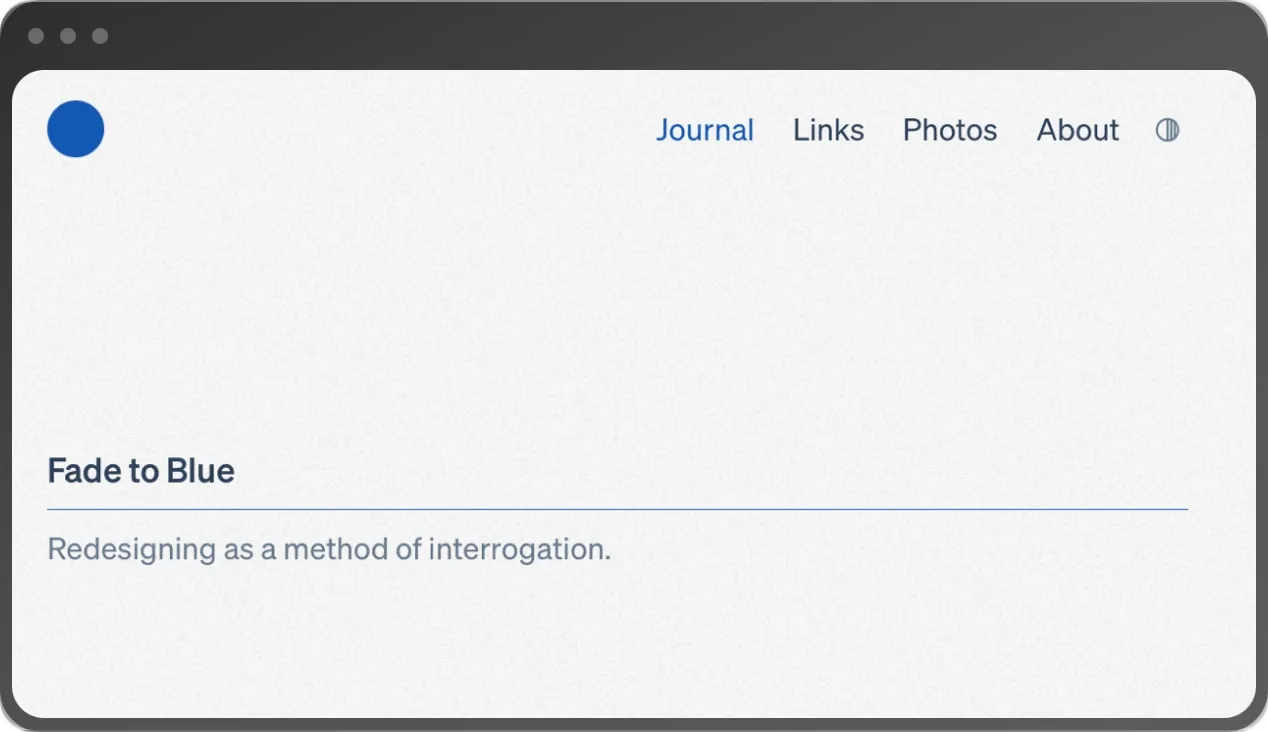
Naz Hamid has redone his website. The impetus seems to have been changing from a color palette that has been adopted as the de facto standard among LLMs. He worried that his visitors would think it was something coded on vibes. So he switched to blues.

I paused to think about what I found inspiring at this time, and what feels fundamentally me. The answer lay in a mix of blueprints, indigo dyes, and selvedge denim. Add in some mid-century Americana via compartmentalized typography, and here we are. In hindsight, I’ve used shades of blue a number of times with Weightshift, but had left it behind. The blues are back.

The site looks good and, even though I have played around with the Claude color palette myself and find it quite pleasing, it’s nice to see something different.

Tech

Robert Rackley

Mere Christian, aspiring minimalist, inveterate notetaker, budget audiophile and paper airplane mechanic. Self-publishing since 1994. Fan of the open web.


Related Posts

Members Public

The Inner Cry of A.I.

Benjamin Wallace writes for the NYT (gift link) about A.I. companies such as Anthropic hiring philosophers. Beyond all the jokes about philosophy grads actually getting jobs, it's a worthwhile examination of the place of the discipline within the tech space. What struck me was the concern that

Members Public

Jokes From Truth

Bluesky CEO, Tony Schneider, was interviewed by Nilay Patel on a recent episode of The Decoder podcast. I like Patel's interview style and thought he brought a good selection of questions to the conversation. After much business strategy and technical discussion, Patel asked Schneider about the common perception

Members Public

R.I.P Dave Kendall

Dave Kendall, creator and host of MTV’s 120 Minutes, has passed away. The British-born Kendall conceived 120 Minutes after joining MTV as a producer, pitching the network a dedicated program for the punk, post-punk, goth, synth-pop, ska, and other underground sounds largely ignored by corporate rock