The Man Who Would Be King

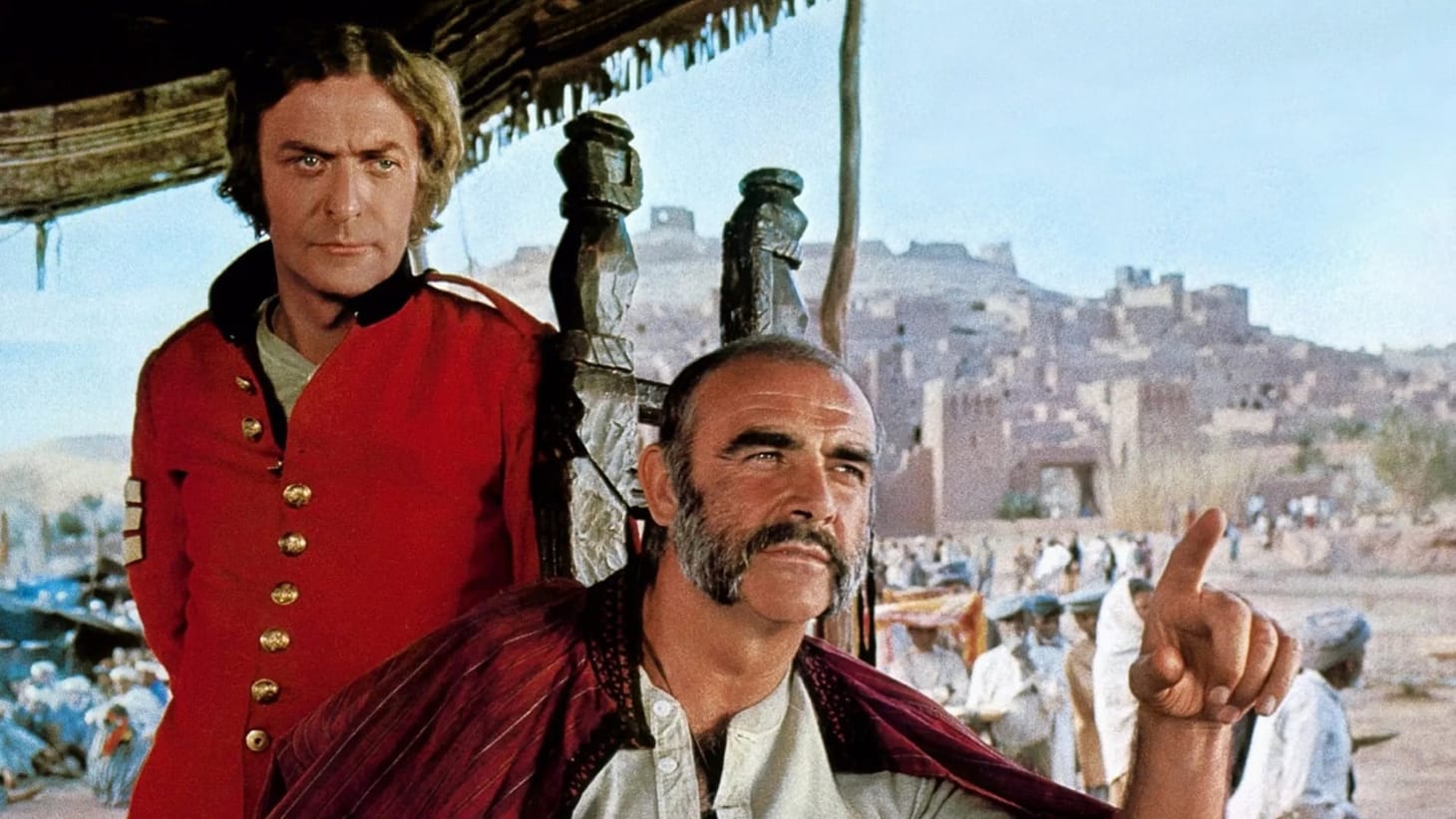
One of my all-time favorite films is John Huston’s The Man Who Would Be King. I was first introduced to the movie adaptation of the Rudyard Kipling short story from 1888 by my English teacher in my senior year of high school. Kipling’s novel encapsulates some of the folly and hubris of the British adventures in Afghanistan in the 19th century by infusing its characters with the attitudes of empire. In the film, Michael Caine and Sean Connery play British ex-military who dream much and doubt their abilities little. They set their sites on bringing the martial prowess learned in their earlier days to a remote area of Afghanistan known as Kafiristan to form their own kingdom.
After crossing treacherous and unforgiving mountains, the film’s two main characters do, little by little, one tribe at a time, find themselves ruling over the natives of the area. Their success owes itself to the guns the men bring with them and their tactical skill in using them to subdue their enemies. They also bring knowledge of governance borrowed broadly from the British Empire, particularly the Dutch East India Trading Company. As their success grows, Connery’s character succumbs to the force of his own internal narrative that he is, as the natives proclaim him to be, the descendent of Alexander the Great. This gives him a god-like status that he comes to embrace, against the protestations of Caine’s character.
Inevitably, the illusion is dispelled and the British adventurers are discovered to be mortal. Their downfall is as swift as it is brutal as the Kafiris drive them out. Their hasty departure mirrors the initial British exit under pressure in Kabul in 1842, which saw only one British soldier survive to reach their destination in Jalalabad. His compatriots at the base there asked him where the army was, to which he famously replied, I am the army.
Only a few short years after the story was published by Kipling, Kafiristan was conquered by Abdur Rahman Khan, who converted the pagan Kafiris to Islam. The area was renamed Nuristan (“land of light”). Nuristan continued to be fairly autonomous, even after the takeover of Afghanistan by the Taliban in the 1990s.
Azam Ahmed tells the tale of how the Americans came to Nuristan after 9/11 and turned an area that was suspicious of the Taliban into a stronghold for the group (NYT gift article). The Americans brought their tactical superiority and advanced weaponry to the area and, over a few years, managed to turn even their initial allies against them by virtually indiscriminate killings and misunderstanding the culture of the area. Even after the American military was essentially driven out by Taliban-backed local militias, they returned simply to bomb the area, murdering civilians and ensuring the populace would never forgive them.
I will be pondering Ahmed’s article for a long time, and I can’t help but think of the parallels to the Kipling story. The analogy isn’t perfect, of course, but it maintains the thread of a more advanced civilization underestimating the power of a more primitive one. Kipling isn’t the only creator to have explored this concept. Even George Lucas mined the idea for his third Star Wars film, Return of the Jedi. Lucas has spoken specifically about the desire to show a simple culture (the Ewoks) defeating a technologically modern military. Many fans have debated the wisdom of making the Ewoks so childish, but the point was made.
The Man Who Would Be King is currently available to stream for free on Tubi.

Treasure Hoard
Sign up for Treasure Hoard to receive email digests in your inbox.